

Striking The Balance: Slip resistance, cleanability, and durability in resin flooring
By Richard Kay, Segment Leader, Manufacturing and Processing - EMEAI

Safety, hygiene, performance. There is a lot to consider when choosing a floor for a manufacturing operation, whether that’s food processing, pharmaceutical, or automotive production.
Because a highly slip-resistant surface will protect against accidents, but may be much harder to clean, while a floor with a fine texture for easy maintenance may not stand up to forklift traffic or heavy automated guided vehicles (AGVs) in the long term.
Understanding where a facility should stand on this spectrum depends on the industry and the use case.
Balancing needs
There are three main considerations for resin floor specifications: slip resistance, ease of cleaning, and durability. Yet improving one often comes at the expense of the others.
Slip resistance is a vital safety feature, protecting staff and visitors from falls. The more textured the surface, the better it grips underfoot. More textured surfaces can also help floors withstand heavy traffic from forklifts, pallet trucks, or trolleys, for example.
However, textured finishes also create small crevices where dirt and residues can collect. This makes cleaning more difficult and can lead to hygiene issues over time.
The challenge is finding the right balance for the environment in question. Both electric vehicle (EV) battery plants and bakeries, for example, have a high-slip risk, due to the use of carbon black and butter, respectively. Hygiene is important for both environments, but they are cleaned in very different ways, one wet and one dry, and this has an important impact on the degree of floor texture that can be used.

Assessing slip risk
Slip risk can be assessed in a number of ways. In the UK, the predominant method is the pendulum test, in which a rubber slider is swung across a floor surface to simulate heel strike. The distance it travels translates to a numerical pendulum test value (PTV).
The Health and Safety Executive (HSE) mandate a minimum PTV of 36 for commonly wet areas. That may include anything from retail spaces, where customers can bring in rain, to pharmaceutical clean rooms, which are regularly cleaned with distilled water, and manufacturing environments, where oils and grease are commonplace.
In continental Europe, the ‘ramp test’ is commonly used. Performed by a person in a harness walking across the surface at an incline, it provides an R-Value ranging from R9 to R13, with R9 being the highest slip risk.
Creating slip resistance
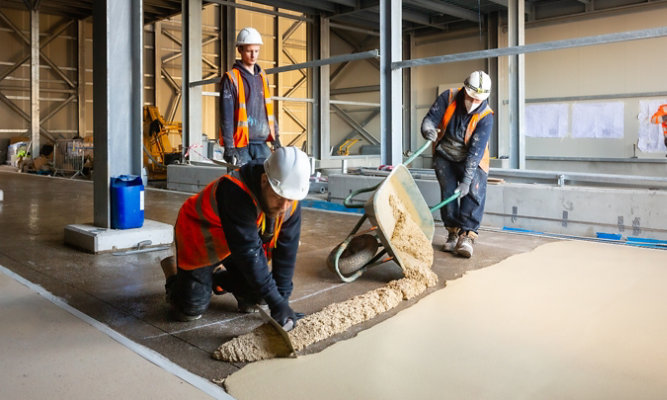
Adding aggregates to the resin before installation creates the texture that provides grip. Not only do the type, size, and shape of aggregate influence slip resistance, but they also play a role in the floor’s durability and cleaning requirements.
Fine polymer beads produce the finest profile. The resulting floors are easy to clean but offer the least durability. It makes them suitable for lighter-duty areas only.
Quartz sand, one of the most common options, has a rounded shape that provides moderate slip resistance and good all-round performance. However, it may wear smooth, affecting PTV and ramp test results, faster than other methods under heavy use.
The triangular shape of aluminium oxide makes it much tougher than quartz sand. As such, it provides higher slip resistance and excellent strength under traffic from pallet trucks or forklifts, for example.
Bauxite offers a high crushing strength, combined with a larger aggregate for increased slip resistance. It is not as hard as aluminium oxide but provides a good balance of durability where very high slip resistance is paramount.

Performing the balancing act
The first step to navigating the flooring balancing act is to match the aggregate choice to the environment.
Understanding the typical hazards, whether they are flour, oils, or powders, in the relevant sector helps determine the level of texture needed. Light-duty spaces with minimal traffic may only need fine polymer beads or quartz sand, while heavy industrial sites with forklift traffic may benefit from aluminium oxide or bauxite.
The next consideration is hygiene requirements. A highly textured floor may be the safest option, but if the facility doesn’t have the right cleaning equipment, performance will quickly deteriorate. Mechanical scrubber driers with appropriate detergents are often essential for textured resin floors, and implementing building cleaning strategies at the start helps avoid operational headaches later on.
It is also a good idea to install multiple samples before starting a project, to test for the correct balance of durability, slip resistance and ease of cleaning. This gives everybody peace of mind in what is a significant investment in protecting people, equipment and the very foundation of the building.
No one-size-fits-all
Ultimately, there is no single solution that fits all industries. But by working closely with flooring specialists and aligning installation choices with day-to-day operations, facilities can strike the right balance between safety, hygiene, and longevity.
Discover More
Industry Expertise and Innovation
See how we help customers find customised solutions for their project and application challenges.

System Lookup
Find out more about our innovative floor systems for a variety of industries.
FIND A SYSTEM