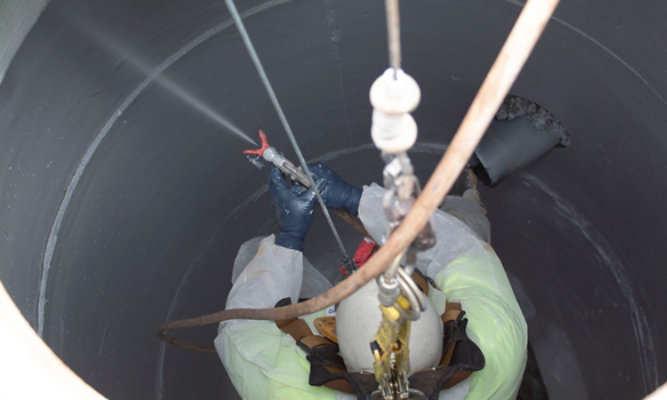
What Are 100% Solids Coatings? A Guide for Water and Wastewater Infrastructure
Water and wastewater infrastructure takes a beating every day.
Inside a wet well, clarifier, pipe, tank, lift station or treatment basin, protective coatings may be exposed to constant moisture, immersion, chemical attack, abrasion, corrosive gases, fluctuating temperatures and demanding cleaning or maintenance cycles. Over time, those conditions can break down unprotected concrete and steel. Coating failure can contribute to corrosion, leaks, structural deterioration, service interruptions, safety concerns and higher lifecycle costs.

For many water and wastewater applications, standard protective coatings may not provide the film build, chemical resistance, low permeability or return-to-service performance needed for severe service environments. In those cases, 100% solids coatings are often considered because they are designed to create a dense, durable and high-build protective barrier with little to no volatile content.
These coatings are not the right answer for every project. No coating system is. But when the asset, substrate, exposure conditions, application environment and performance requirements call for a robust protective lining, 100% solids coatings can play an important role in protecting water and wastewater infrastructure.
In this article, we break down what 100% solids coatings are, how they work, where they are commonly used and when they make sense for water and wastewater facilities.
100% Solids Coatings: An Overview
The term “100% solids” refers to the portion of a coating that remains on the surface after the coating cures.
In many conventional coatings, part of the wet material applied to the surface evaporates as the coating dries or cures. As that solvent or water leaves the film, the final dry film thickness becomes lower than the original wet film thickness.
With a 100% solids coating, essentially all of the applied material is designed to become part of the cured film. As a result, the wet film thickness and dry film thickness are typically very close, depending on the product, application method, environmental conditions and curing process.
Many 100% solids coatings used in industrial environments are two-component epoxy or urethane systems that cure through a chemical reaction. Once properly mixed and applied, they form a dense protective film over the prepared substrate. For water and wastewater infrastructure, that film can help protect concrete, steel, ductile iron and other properly prepared substrates from moisture intrusion, chemical exposure, corrosion, abrasion and deterioration.
That said, “100% solids” is not a performance guarantee by itself. The final result still depends on the chemistry, formulation, surface preparation, application process, film thickness, cure conditions, inspection and service environment.
Key Characteristics of 100% Solids Coatings
100% solids coatings are often selected for demanding applications because of the way they build film, cure and protect the substrate. While performance varies by product, several characteristics make these systems especially relevant in water and wastewater environments.
High Film Build
One of the main advantages of 100% solids coatings is their ability to build film thickness efficiently. Because most or all of the applied material remains in the cured coating, these systems can often achieve higher dry film thicknesses than lower-solids coatings. In many applications, this process helps create a thicker barrier between the substrate and the exposure environment.
In water and wastewater facilities, concrete and steel assets are often exposed to immersion, corrosive gases, acidic conditions, treatment chemicals and abrasive flow. A higher-build lining can help provide the physical and chemical separation needed to protect the asset beneath it.
Low VOC or Near-Zero VOC Profile
Most 100% solids coatings contain little to no solvent, which often results in a low VOC or near-zero VOC profile.
Many water and wastewater assets are located in confined or semi-confined spaces. Tanks, pipes, wet wells, manholes, lift stations, vaults and enclosed treatment structures can create challenging application environments. Reducing solvent emissions may support environmental goals and help limit solvent-related concerns during application.
Low VOC content does not eliminate the need for proper safety practices. Ventilation, personal protective equipment, confined-space protocols, air monitoring and application controls are still essential. But when VOC reduction is a project priority, 100% solids systems may offer a practical advantage over solvent-heavy alternatives.
Minimal Shrinkage During Cure
Lower-solids coatings can lose volume as solvents or water leave the film. With 100% solids coatings, there is little material loss through evaporation, so the cured film usually retains much of the applied thickness, which can make film build more predictable and help applicators achieve specified dry film thickness targets.
In severe service environments, that predictability is crucial. Underbuilding the film can compromise protection, while overbuilding beyond product limits can create its own risks. A properly specified and applied 100% solids coating can support more controlled film thickness in high-performance lining applications.
Dense Barrier Protection
Water and wastewater assets often need surface coverage as well as barrier protection. A dense coating film helps slow the movement of water, chemicals, ions, gases and other corrosive agents toward the substrate, which is especially important for submerged or intermittently submerged structures, concrete exposed to wastewater chemistry and steel exposed to corrosion-promoting environments.
In wastewater facilities, protective linings may need to resist a combination of moisture, hydrogen sulfide gas, sulfuric acid formation, low-pH conditions, microbial activity and chemical cleaning. In water facilities, coatings may need to protect assets while meeting strict requirements for potable water contact. In both cases, low permeability and barrier performance are central to long-term protection.
Chemical and Corrosion Resistance
Many 100% solids coatings are formulated for chemical and corrosion resistance.
In wastewater environments, this may include resistance to hydrogen sulfide-related corrosion, sulfuric acid generated through microbial activity, treatment chemicals and aggressive immersion conditions. In water treatment and storage applications, coatings may need to resist continuous immersion, disinfection chemicals and long-term exposure to treated water.
The key is matching the coating system to the actual exposure. A product used for a wastewater headspace environment may not be the same product used for potable water immersion, and a lining used in a digester may not be appropriate for a tank carrying treated drinking water. The chemistry, approvals and service conditions all make a difference.
Abrasion and Impact Resistance
Water and wastewater structures are also exposed to physical wear. Grit, suspended solids, turbulent flow, mechanical cleaning, maintenance activity and moving water can all contribute to abrasion. In areas such as headworks, influent channels, wet wells, clarifiers and pipe interiors, abrasion resistance can be an important part of long-term coating performance.
High-build 100% solids systems may provide added protection in these environments by creating a tough, durable lining that helps shield the substrate from both chemical and mechanical stress.
Fast Return-to-Service Potential
Downtime is a major concern for water and wastewater facilities. Critical assets often cannot remain offline for long without affecting treatment capacity, service reliability or operational flexibility.
Certain 100% solids coatings are engineered for faster cure and return to service. When paired with the right surface preparation, application process, inspection and environmental conditions, these systems may help shorten project timelines compared with coating systems that require longer cure times or multiple coats.
Actual return-to-service time depends on the product, film thickness, temperature, humidity, substrate condition, exposure type and project requirements.
Application-Specific Handling Requirements
100% solids coatings can offer significant performance advantages, but they are not casual “open the bucket and roll it on” systems.
Many require precise mixing, close attention to pot life, proper plural-component equipment or specialized spray equipment, trained applicators, correct surface preparation and controlled application conditions. Some are more forgiving than others, but high performance coatings should always be treated as part of a full system rather than a standalone material.
Common Usage Examples in the Water and Wastewater Industry
100% solids coatings are used across many industrial environments where durable, high-build protection is required. Common applications may include tank linings, pipe linings, secondary containment areas, industrial floors and walls, steel and concrete protective linings, chemical processing areas and immersion service environments.
Within the water and wastewater sector, they are commonly considered for assets that face moisture, corrosion, chemical exposure, abrasion or difficult access.
Wastewater Collection Systems
Wastewater collection systems often present some of the most aggressive conditions in the infrastructure lifecycle. Manholes, wet wells, lift stations, splitter boxes, influent channels, sewer collection structures, concrete pipe and steel pipe can all be exposed to hydrogen sulfide gas, microbial activity, sulfuric acid formation, abrasion and intermittent or continuous moisture. These conditions can deteriorate concrete and corrode steel if the asset is not properly protected.
100% solids coatings may be used as high-build linings in these environments to help create a durable barrier against corrosive wastewater exposure.
Wastewater Treatment Facilities
Inside treatment facilities, coatings and linings are used across many process areas, including headworks, clarifiers, digesters, aeration basins, sedimentation basins, intake structures, process tanks and other concrete or steel treatment structures.
Each of these assets has its own exposure profile. A digester, for example, may experience different conditions than a clarifier, while a headworks structure faces more abrasion and chemical variability than another area of the plant.
100% solids coatings can be especially relevant where high-build protection, chemical resistance, low permeability and long-term durability are required.
Potable Water and Water Storage Applications
Some 100% solids coatings are used in potable water applications, including potable water tanks, ground storage tanks, elevated tanks, concrete potable water tanks, pressure vessels, pipe interiors, valves, gates and related components.
However, potable water applications require extra care. Coatings used in contact with drinking water must meet applicable certifications, approvals and project requirements. Not all 100% solids coatings are suitable for potable water service.
For potable water tanks and related assets, product selection should account for regulatory requirements, immersion conditions, substrate type, cure schedule, water quality, cleaning procedures and applicable standards.
Transmission Pipe and Conveyance
Water and wastewater systems rely on pipe infrastructure to move water, wastewater and process flows safely and reliably.
Steel transmission pipe, ductile iron pipe, concrete pipe, interior pipe linings and exterior pipe coatings may all require protective systems depending on the exposure and project design. In pipe interiors, coatings may need to resist immersion, abrasion, flow conditions and cleaning cycles. In exterior environments, coatings may need to resist soil exposure, moisture, corrosion and installation damage.
100% solids systems may be considered when a high-build, durable lining or coating is needed for the specific pipe material and service environment.
Benefits of 100% Solids Coatings
The value of 100% solids coatings goes beyond technical performance. The real value is what those technical characteristics can mean for asset life, maintenance planning, downtime and lifecycle cost.
Extended Asset Life
Water and wastewater infrastructure is expensive to build, difficult to replace and often expected to remain in service for decades. Protective coatings can help extend asset life by shielding concrete and steel from conditions that lead to corrosion, chemical attack, moisture intrusion and deterioration.
When properly selected, applied and maintained, 100% solids coatings can help reduce the frequency of repair or recoating cycles in demanding environments, which can be especially valuable for assets that are hard to access, costly to shut down or critical to facility operations.
Strong Protection in Severe Service Environments
Some water and wastewater assets operate in conditions that basic coating systems were never designed to handle.
Wastewater headspace environments can expose surfaces to hydrogen sulfide gas and sulfuric acid formation. Collection systems can experience microbial corrosion and constant moisture, while treatment structures may face immersion, abrasion, chemicals and cleaning processes. At the same time, potable water assets require long-term immersion performance under strict quality requirements.
100% solids coatings can help provide the high-build barrier protection needed in these severe service environments, depending on the product and specification.
Lower VOC Exposure Compared with Solvent-Based Systems
Because many 100% solids coatings contain little to no solvent, they reduce VOC emissions during application and cure compared with solvent-based systems. In confined or enclosed water and wastewater structures, where ventilation can be difficult and worker-safety planning is essential, lower VOC content may also help facilities support environmental goals or comply with project-specific VOC restrictions.
Low VOC does not mean low risk. Applicators still need to follow product data sheets, safety data sheets, confined-space requirements and jobsite safety protocols.
Higher-Build Application Efficiency
In many applications, achieving the required dry film thickness can take multiple coats when using lower-solids materials. Since 100% solids coatings retain most or all of the applied material in the cured film, they may allow applicators to reach high-build specifications in fewer passes or coats, depending on the product and project requirements.
It can make a meaningful difference on large tanks, basins, pipe interiors or structures where access is difficult. Fewer coats may also reduce labor time, cure intervals, inspection steps and overall project duration.
Reduced Downtime and Faster Return to Service
Every hour of downtime matters when a critical water or wastewater asset is offline.
Fast-curing 100% solids systems help reduce the time required between application and return to service. They can be especially valuable for municipalities, utilities and industrial facilities that need to maintain capacity, meet treatment obligations and avoid extended service interruptions.
The best results come from planning. Surface preparation, application sequencing, environmental controls, inspection and cure verification all affect whether the asset can be returned to service within the desired window.
Better Lifecycle Value
A 100% solids coating system may cost more upfront than a basic coating option, but it’s not necessarily more expensive.
For critical infrastructure, the lowest material cost is rarely the smartest measure of value. Asset owners also need to consider surface preparation, labor, downtime, maintenance frequency, repair risk, service interruption, recoating cycles and the potential cost of failure.
A higher performance coating system, like 100% solids coating, can create better lifecycle value when it helps extend service life, reduce emergency repairs, limit shutdowns and protect assets in severe environments.
Versatility Across Steel and Concrete Assets
Water and wastewater facilities include a wide range of substrates and structures. Properly selected 100% solids coatings may be used on steel, concrete, ductile iron or other prepared substrates, depending on the product. This versatility makes them relevant across many parts of a facility, from concrete wet wells and manholes to steel tanks, pipe interiors, gates, valves and process structures. The key is selecting a system designed for the substrate and exposure conditions.
When to Use 100% Solids Coatings for Water and Wastewater Infrastructure
100% solids coatings are chosen when the service environment, substrate condition, downtime window, performance requirement or regulatory context calls for a high-build, low-permeability protective lining system.
Here are some of the situations where these coatings may be the right fit.
1. When Assets Face Immersion Service
Immersion is one of the most demanding conditions for a coating system. Tanks, pipes, clarifiers, basins, wet wells, digesters and other structures may be continuously or intermittently submerged. In these environments, the coating must resist water intrusion, chemical exposure, osmotic pressure and substrate degradation over time.
100% solids coatings designed for immersion service can help create a thick, durable barrier between the substrate and the liquid environment, providing steel corrosion protection and concrete protection in water and wastewater assets.
2. In Severe Wastewater Environments
Wastewater environments can be chemically aggressive and highly variable.
Hydrogen sulfide gas, microbial activity, sulfuric acid formation, low-pH conditions, grit, flow turbulence and moisture can all contribute to deterioration. These exposures are common in collection systems, headworks, lift stations, wet wells, digesters and other severe wastewater areas. In these conditions, 100% solids high-build systems may help protect the substrate by creating a dense barrier against corrosive gases, liquids, acids and moisture.
3. When Concrete Needs Protection or Rehabilitation
Concrete is strong, but it’s not immune to wastewater exposure.
Over time, chemical attack, abrasion, moisture intrusion, microbial activity and low-pH conditions can damage concrete surfaces. In wastewater environments, it can lead to surface erosion, exposed aggregate, section loss, leaks and structural concerns. A 100% solids lining system helps protect new concrete or rehabilitate existing concrete surfaces, depending on the condition of the asset.
However, coating should not be used as a shortcut around proper repair. Damaged concrete may require cleaning, profiling, patching, resurfacing, moisture evaluation and structural assessment before a coating is applied. The coating is only as good as the surface beneath it.
4. When Steel Needs Corrosion Protection
Steel tanks, pipes, vessels, gates, valves and miscellaneous metals are all vulnerable to corrosion when exposed to water, wastewater, chemicals or atmospheric moisture. A properly selected 100% solids coating can provide a high-build barrier that helps separate steel from corrosive exposure, which may be useful in immersion service, wastewater structures, potable water storage, process tanks and pipe interiors.
As with concrete, surface preparation is critical. Steel must be cleaned and prepared to the specified standard before coating application. Contamination, inadequate profile, flash rust or poor environmental controls can compromise adhesion and long-term performance.
5. When Downtime Must Be Minimized
Many water and wastewater facilities operate under tight maintenance windows.
A utility may not have the luxury of taking a clarifier, wet well, tank or lift station offline for an extended period. Industrial wastewater operations need to keep production-related treatment assets running, and municipal systems have to maintain capacity during peak demand or seasonal conditions.
Most 100% solids coatings are designed for rapid cure and faster return to service, which can help reduce downtime when the project is planned correctly. It also makes them attractive for maintenance, rehabilitation and lining projects where speed is a priority.
6. In Confined or Enclosed Areas Where VOC Is Critical
Water and wastewater work often happens in difficult spaces. Manholes, wet wells, tanks, pipes and vaults can be confined, enclosed or poorly ventilated. In these areas, lower VOC systems may help reduce solvent-related concerns during application.
100% solids coatings can be a strong option when VOC reduction is important, but they still require full safety planning. Confined-space entry procedures, air monitoring, ventilation, PPE, trained crews and compliance with safety requirements remain essential.
7. When Standards or Approvals Apply
Water and wastewater projects often need to meet specific standards, certifications or regulatory requirements.
For potable water applications, coatings may need to comply with standards such as NSF/ANSI/CAN 61 and NSF/ANSI/CAN 600, and pipe lining projects should align with AWWA standards depending on the system type and project scope. Tank coating projects involve standards tied to tank design, inspection, surface preparation, coating selection and performance requirements.
Product selection should always be tied to the asset, exposure, substrate, operating conditions and applicable standards. A coating may be 100% solids and still not be approved for the specific use.
8. When Lifecycle Cost Matters More Than Lowest Initial Cost
For critical infrastructure, the cheapest coating on bid day can become the most expensive option over time.
If a lower-cost coating fails early, the owner may face emergency repairs, shutdowns, recoating costs, bypass pumping, lost capacity, safety concerns and regulatory pressure. A higher-performance 100% solids coating can deliver stronger lifecycle value if it helps extend service life and reduce maintenance frequency.
The right question is not simply, “What does the coating cost?” but, “What does it cost if this asset fails?”
When 100% Solids Coatings May Not Be the Right Fit
100% solids coatings may not be necessary when the asset does not face severe exposure, immersion, chemical attack, abrasion or high performance requirements. They may not be practical when the project budget is focused only on short-term cost, when the surface cannot be properly prepared or when jobsite conditions don’t support the required application and cure window.
Additionally, 100% solids coatings might be the wrong choice if the applicator does not have the right training, equipment or experience. Some products require plural-component spray equipment, careful temperature control, strict mix ratios and precise application techniques. Poor application can undermine even the best coating chemistry.
For potable water, wastewater and other regulated applications, the coating must also carry the required approvals for the intended use. A 100% solids formulation alone does not make a product suitable for every water or wastewater environment.
FAQs About 100% Solids Coatings
What Does 100% Solids Mean in Epoxy Coatings?
100% solids means the coating is formulated so that essentially all applied material remains in the cured film. Unlike lower-solids coatings, there is little to no solvent or water leaving the film during drying or curing, which can help the coating achieve high dry film thickness more efficiently.
Are 100% Solids Coatings the Same as High-Solids Coatings?
No. High-solids coatings contain a high percentage of film-forming material, but they may still include some solvent or other volatile components. A 100% solids coating is formulated so that essentially all applied material becomes part of the cured film. Performance, VOC content, cure time and application requirements still vary by product.
Are 100% Solids Coatings Always Zero VOC?
Not always. Many 100% solids coatings are very low VOC or near-zero VOC, but VOC content should always be verified on the product data sheet and compared against local regulations and project requirements.
Why Are 100% Solids Coatings Used in Wastewater Environments?
They are often used because wastewater environments can be highly corrosive and abrasive. 100% solids coatings can provide high-build barrier protection, chemical resistance, low permeability, abrasion resistance and durability in areas exposed to wastewater immersion, hydrogen sulfide, sulfuric acid formation, microbial corrosion and low-pH conditions.
Can 100% Solids Coatings Be Used for Potable Water Tanks?
Some 100% solids coatings can be used for potable water applications, but only products with the proper potable water approvals and certifications should be selected. Product choice must align with the asset, service conditions, applicable standards, cure requirements and regulatory expectations.
What Substrates Can 100% Solids Coatings Be Applied to?
Depending on the product, 100% solids coatings may be applied to properly prepared concrete, steel, ductile iron or other substrates. Surface preparation is critical. The substrate must be clean, sound, profiled and prepared according to the project specification and product requirements.
Are 100% Solids Coatings Harder to Apply?
They can be more demanding than some conventional coatings. Many require careful mixing, attention to pot life, trained applicators, proper equipment, surface preparation and environmental controls. Technical guidance is important, especially for severe service water and wastewater applications.
How Thick Are 100% Solids Coatings Applied?
Application thickness varies by product, asset, exposure and specification. Many 100% solids coatings are designed as high-build systems, but the correct film thickness should always be based on the product data sheet, service environment and project requirements.
How Do I Know If a 100% Solids Coating Is Right for My Project?
To determine if a 100% solids coating is right for your project, evaluate the asset type, substrate, exposure conditions, downtime window, VOC requirements, regulatory standards and lifecycle goals. A coating specialist can help determine whether a 100% solids system is appropriate and which product best matches the project conditions.
Shop 100% Solids Coatings for Water and Wastewater Infrastructure at Sherwin-Williams
100% solids coatings can offer high-build protection, low permeability, strong chemical resistance, low VOC potential and durable performance in demanding environments. For water and wastewater infrastructure, those qualities can be especially valuable in assets exposed to immersion, hydrogen sulfide, microbial corrosion, sulfuric acid formation, abrasion, corrosion and tight return-to-service windows.
The right system depends on the asset, substrate, surface condition, exposure environment, application method, cure window, regulatory requirements and long-term performance goals. A 100% solids coating can be an excellent fit when the project demands severe-service protection, but it must be selected and applied correctly.
At Sherwin-Williams, we offer coating and lining systems designed for the unique challenges of water and wastewater infrastructure, along with technical support to help owners, engineers and contractors match the right system to the right environment.
Need help determining whether a 100% solids coating is right for your water or wastewater asset? Contact us today to discuss your project conditions, exposure environment, substrate, timeline and performance requirements.
Articles
Industry Expertise and Innovation
Read about water and wastewater coatings and linings, learn which products are better for various applications, and how we can assist you from spec to protect.
See All