Best Practices for Repairing Industrial Floor Cracks
How Proactive Fixes Protect Facility Cleanliness, Safety, Performance – and Uptime
by Feraas Alameh, Market Segment Manager – Food & Beverage, Michael Starner, Market Segment Manager- Sherwin-Williams High Performance Flooring, Dustan Bible, Technical Service Manager - Sherwin-Williams High Performance Flooring

A small crack in a facility floor can be easy to ignore. One week, it’s a hairline near a cart path. The next, it’s creeping through a high-traffic zone – raising concerns about sanitation, safety or equipment wear.
Left unaddressed, even a minor fracture in a seamless industrial flooring system can grow under the stress of daily operations. Repeated impacts from carts and forklifts, vibration from nearby equipment, temperature fluctuations and the demands of cleaning protocols all contribute to worsening damage. Each footfall, wheel pass or thermal cycle adds to the stress – threatening not just the floor, but the facility’s broader integrity.
In food processing or pharmaceutical production, small cracks can become harborage points for bacteria. Once contaminants penetrate the surface, routine sanitizing may no longer be enough – jeopardizing hygiene protocols and increasing the risk of audit failures or shutdowns. In warehouse or packaging spaces, a crack can catch a tire or a toe, widening with every pass and creating a growing safety hazard. In electronics assembly or data centers – where even trace dust can disrupt sensitive equipment – cracks can compromise cleanliness and performance.
The good news: resinous flooring cracks are generally straightforward to repair when addressed early and correctly. But success depends on first understanding whether a crack is static (stationary) or dynamic (still moving) and then selecting repair materials suited to the environment, exposure risks and existing floor system.
This paper outlines practical steps for identifying and addressing floor cracks in industrial settings – helping facilities avoid bigger issues, maintain hygiene and safety standards and extend the life of their flooring investment.
Crack Hazards
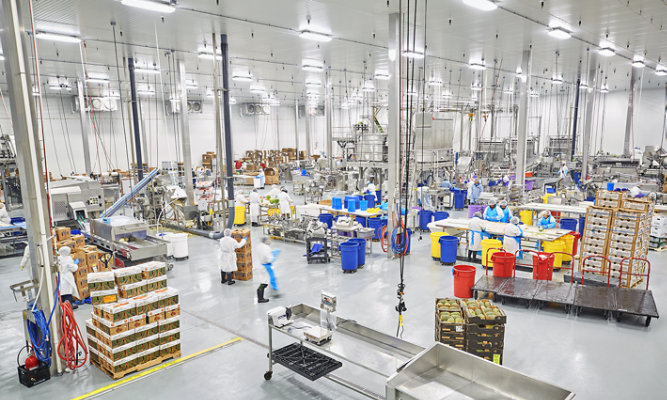
Cracks in seamless resinous flooring systems can appear across a wide range of manufacturing, processing and production environments. While often small at first, they tend to form and spread in high-traffic zones, around equipment and anywhere floors face physical, chemical or environmental stress.
Traffic is a leading factor – whether from rolling carts in packaging areas, forklifts in distribution zones or consistent foot traffic through corridors and break rooms. Loading docks are especially prone to damage, with repetitive forklift action and trailer movements compounding wear. Likewise, vibration from heavy machinery can initiate or worsen cracking, especially near anchor points.
Aggressive cleaning procedures are another major contributor. High-temperature washdowns, chemical disinfectants and UV-based sanitation protocols can all degrade flooring materials – particularly those not designed for such exposure. In chemical storage areas, spills may corrode the surface or damage the concrete substrate, compounding the problem.
Temperature swings also take a toll. Cold storage rooms, freezers and temperature-controlled spaces are vulnerable to thermal cycling, which causes flooring to contract and expand repeatedly. Transition zones – between ambient and refrigerated areas – often see the worst of this effect, especially in food and pharmaceutical facilities where moisture levels add another layer of stress.
Unchecked, these cracks may grow from cosmetic concerns into safety and operational hazards.
Each new pass of a boot, tire or caster deepens the damage, turning a minor flaw into a trip hazard or a cause of equipment instability. Eventually, remediation may require extensive resurfacing instead of a simple repair – disrupting schedules and raising costs.
Hygiene is another major concern. Once a crack opens even slightly, moisture and organic material can enter and settle below the surface. That lip becomes a shelter for bacteria, one that’s nearly impossible to fully clean. Over time, delamination can occur – widening the damage and allowing further contamination. In facilities that depend on strict sanitation regimens, such as food processors or pharmaceutical producers, cracks jeopardize cleanliness and regulatory compliance.
The risks extend to cleanroom and electronics environments as well. Here, cracks can compromise electrostatic discharge (ESD) flooring systems or shed particulates that threaten circuitry. Even small amounts of dust can degrade chip quality or damage hard drives. In addition, if ESD continuity is broken by a single crack, sensitive devices may be exposed to damaging shocks – making crack repair essential to quality assurance in these high-precision settings.
Designing Floors to Prevent Future Cracking
With safety and productivity at stake – and potentially the bottom line if a contamination event, injury or dust particle release were to occur – it’s best to repair any crack in a resinous flooring system as soon as possible. It’s also important to take proactive steps to reduce the chance of cracks forming in the first place. That prevention begins with the concrete pour, since cracks in the substrate can telegraph upward into the flooring system installed on top.
Minimizing cracking in new concrete is the responsibility of the contractor, who must prioritize proper surface preparation and curing practices. That includes making sure the subgrade is thoroughly compacted, using a low water-to-cement ratio and adding reinforcement where needed. Best practices also call for appropriate placement of control and expansion joints. Ideally, the concrete should cure for at least 30 days before flooring is installed – giving time for early cracks to form and be addressed. When schedules don’t allow for that curing window, installers can choose specialized coatings compatible with green concrete, which help accommodate continued slab movement as curing completes.
The American Concrete Institute (ACI) recommends waiting 60 to 90 days before filling joints in an industrial floor slab – or at least delaying as long as possible. This gives control and construction joints time to open closer to their final width due to shrinkage. In freezer or cooler areas, ACI also suggests stabilizing the floor at its final operating temperature for seven days before flooring installation. The same guidance applies to treating cracks in those areas.
When it’s time to install the resinous system, flooring is less likely to crack if the building has already been acclimated to in-use conditions. That means it’s fully enclosed and the HVAC system is running – allowing the concrete and other building materials to dry, shrink or expand as they would under regular operations. This step goes a long way toward minimizing stress and cracking in the finished flooring system.
That said, ideal conditions aren’t always possible. Regardless of conditions, success depends on collaboration among facility teams, manufacturers and installers to match the system to the environment and expected use. That planning phase is the right time to consider crack-resistant design elements, like membrane crack fillers that bridge minor cracks in the concrete and help shield the resinous surface from underlying slab movement. In some cases, it may also make sense to install the flooring system around expansion joints and fill those areas later, after full building acclimation, to reduce the risk of cracking and bring about proper joint integration.
Despite every precaution, cracks may eventually form. When they do, prompt repair using the appropriate protocols is the best defense – both for the floor and for the operations it supports.
Concrete cracks may occur anywhere throughout food and beverage facilities and should be addressed using the proper repair techniques depending on the type of crack that exists.
Areas around heavy equipment that vibrates are prone to cracking, particularly at and near attachment points.
It’s important for food and beverage processing facilities to promptly repair cracks to eliminate bacteria harborage points and enhance food safety.
Repairing Dynamic (Active) Cracks
Dynamic cracks are active – meaning the cause of the cracking is still in play. They can result from thermal fluctuations, repetitive loads, freeze-thaw cycles or other environmental and mechanical forces. While some cracks (such as those forming at cold joints) can be anticipated, most dynamic cracks appear without warning and require careful consideration before repair.
Shifting or settling of the sub-base after construction is a common culprit. Even if the movement seems to have stopped, the cracks should still be treated as active. The same approach applies to heaving cracks caused by soil conditions such as moisture-heavy clay, poor drainage, frost heave or aggressive root systems – all of which can lift the slab and stress the flooring above it.
Another common source of dynamic cracks is seismic activity. These cracks can result from both natural ground shifts and man-made vibrations, such as those produced by nearby rail lines or heavy industrial traffic. In such cases, the priority is not just repair, but also isolation: identifying the source and determining how best to decouple the flooring system from further movement.
No matter the type, dynamic cracks may signal deeper structural issues. Repair teams and facility managers should always identify the root cause before proceeding. If there are signs of visible heaving or measurable ongoing movement, a structural engineer should be consulted before initiating repairs. Otherwise, surface fixes may fail prematurely.
Because dynamic cracks remain susceptible to continued stress, repairs must account for that motion. The standard method is to sawcut through the existing flooring system and fill only the two sides of the joint – not the bottom – to achieve two-point adhesion (Figure 1). This allows the system to flex without transferring forces upward, reducing the likelihood of failure.
To create the notch, use a diamond-blade saw attached to a vacuum system to minimize dust. Cuts should reach a depth of ¾" and a width of at least ¼", providing enough surface area for strong bond formation between the repair material and the substrate.
Next, a bond breaker – typically a closed-cell backer rod – should be inserted into the cut. It must be 1/8" wider than the joint to prevent resin from reaching the bottom. This is a must: if the repair adheres on all three sides, it will not be able to move and is likely to crack under stress. The bond breaker allows the flooring material to flex downward into the joint, as needed.
The filler material used will depend on the environment. For example, a semi-rigid urethane cement may be preferred in areas exposed to heat or thermal shock. For facilities requiring rapid turnaround, fast-curing polyurea is often ideal – and can also be used in colder settings. For freezer or cold storage areas with temperatures down to 20°F, methyl methacrylate (MMA) is often the go-to.
Figure 1. Best practices for repairing dynamic cracks include cutting a minimum 1/4" wide by 3/4" deep notch through the finished flooring system and concrete before adding a backer rod and applying flexible joint material on top. The backer rod prevents three-point adhesion, allowing the repair material to move downward with expansion, rather upward where it may cause a repair to crack.
Material selection should match both the surface conditions and performance needs. Resuflor™ 3580 is a semi-rigid filler that balances hardness and flexibility, helping absorb impact from heavy wheeled traffic while supporting edge loads. If flexibility isn’t required, Resuflor™ 3500 offers a more rigid solution that won’t elongate once cured. For vertical surfaces, or when sag resistance is important (such as cove bases), Loxon® 1K provides a non-sag, rubber-like sealant that adheres to many substrates and maintains resilience.
In all cases, the key is matching the product not just to the crack – but to the forces still acting on it. Because when it comes to dynamic cracks, proper preparation is what prevents the repair from becoming the next failure point.
Repairing Static (Dormant) Cracks
Static cracks differ from dynamic ones in a key way: they’re dormant. These cracks either no longer move or shift so minimally that repairs made over them remain intact. That doesn’t mean they can be ignored – but it does mean repairs are simpler and more predictable.
One common static crack type is craze cracking – hairline fissures in the concrete’s surface cream or laitance. Often caused by overly rapid drying, they tend to be shallow and cosmetic rather than structural. Because of that, craze cracks rarely need aggressive remediation. Most flooring primers are designed to bridge over these imperfections, forming a continuous film that prevents them from telegraphing through the finished flooring.
Plastic shrinkage cracks also fall under the static category. These form in the first few hours after pouring, while the concrete is still plastic. As water evaporates from the surface too quickly, hairline cracks may form. Most plastic shrinkage cracks are harmless, but it’s essential to confirm they’re not still growing or showing signs of heaving. During new concrete pours, proper placement of control joints – per ACI 302.1R-15 – can help prevent their formation.
Other static cracks can appear at control joints, which are intended to crack or from surface damage over time. When identified during flooring prep, these cracks can be effectively mitigated using patching materials like sealants or fiberglass mesh.
Before applying any filler, installers must prep the area. That includes removing all laitance, debris and surface sealers to create a durable bond. Next, make a sawcut over the crack using a V-notch blade with a vacuum attachment to collect dust from the sawing process (Figure 2). This V-notch profile provides more bonding surface area than a straight blade, essentially creating a Concrete Surface Profile (CSP) of 1 to 2 – ideal for proper adhesion.
For repairs on elevated slabs – such as second-floor or mezzanine applications – it’s best practice to use a fiberglass mesh material for reinforcement (Figure 3). Mesh increases tensile strength, reducing flex-related stresses on both the concrete and the flooring above. On ground-level slabs, where the concrete doesn’t flex, mesh reinforcement usually isn’t necessary.
Material selection depends on crack size, temperature demands and compatibility with the existing floor. For smaller cracks (under ¼"), epoxy fillers are often used. These may be self-leveling or trowel-applied. A common formulation is Resuflor™ Glaze with Cab-O-Sil® – a blend of one pint hardener, one quart resin and three quarts Cab-O-Sil. For cracks over ¼", installers can add Resuflor™ Screed III (with silica sand aggregate) or use thicker products like Resuflor™ MPE.
Cementitious urethane and MMA systems follow similar sizing logic. For example, Poly-Crete™ SL or MD work well for small repairs, while Poly-Crete™ WR is suited for larger cracks and high-heat conditions. MMA systems, like Crylaflor™ SL Filler or Crylaflor™ Tex, offer fast cure times and are ideal when quick return-to-service is paramount.
By understanding the nature of static cracks – and selecting materials designed to match floor type and environmental factors – facilities can promote lasting performance in even the most demanding manufacturing and processing areas.
Making Crack Prevention Part of Your Maintenance Strategy
While large, visible cracks in flooring often demand immediate attention, smaller hairline or surface-level cracks – such as those from craze cracking or plastic shrinkage – can be easy to dismiss.
But regardless of size or visibility, any crack left unaddressed can worsen over time. Dynamic cracks caused by shifting sub bases, seismic activity or freeze-thaw cycles may expand or move. Even seemingly minor static cracks could weaken over time if conditions change. The result? A growing problem that risks food and pharmaceutical safety violations, injuries and even full plant shutdowns.
Timely repairs are one of the most reliable ways to prevent costlier interventions down the line. And so is identifying issues before they evolve. For example, conducting regular site audits with experienced flooring system providers can help facilities catch problems early – before an inspector does. These audits can also surface at-risk areas, such as cold joints, slab transitions or high-traffic zones that may require preventive maintenance.
By applying the appropriate repair methods and materials described above, facilities can stay ahead of crack-related failures and strengthen both operational continuity and safety – protecting not only the floor but also the people and processes that depend on it.
Figure 2. Best practices for repairing dynamic cracks include cutting a minimum 1/4" wide by 3/4" deep notch through the finished flooring system and concrete before adding a backer rod and applying flexible joint material on top. The backer rod prevents three-point adhesion, allowing the repair material to move downward with expansion, rather upward where it may cause a repair to crack.
Figure 3. Best practices for repairing dynamic cracks include cutting a minimum 1/4" wide by 3/4" deep notch through the finished flooring system and concrete before adding a backer rod and applying flexible joint material on top. The backer rod prevents three-point adhesion, allowing the repair material to move downward with expansion, rather upward where it may cause a repair to crack.
During the restoration of this food and beverage processing facility floor, installers first removed the existing flooring (top), bringing it down to bare concrete for a clean, prepared surface. Next, they followed proper crack filling protocols for repairing both dynamic (shown as the straight, parallel and perpendicular lines) and static (shown as the wavy lines) cracks (middle). Finally, they applied a full coat of resinous flooring material over top to restore the facility for operation (bottom).
ABOUT THE AUTHORS
Feraas Alameh is Market Segment Manager, Food & Beverage for Sherwin-Williams. He has 15 years of experience in the coatings industry, leading various market segments with an emphasis on business and market strategy, particularly in consumer packaged goods and industrial coatings. He earned his bachelor’s degree from Cleveland State University and has completed continuing education programs at the Weatherhead School of Management at Case Western Reserve University and the Fisher College of Business at The Ohio State University. Contact: Falameh@sherwin.com
Michael Starner is Market Segment Manager for Sherwin-Williams High Performance Flooring. He has been in the coatings industry with Sherwin-Williams for 28 years. He has held various sales, management and marketing roles and has spent the last 10 years working with the design community to select and specify the proper high-performance floor and wall systems for their clients. Starner is NACE Level 3 certified. Contact: Michael.Starner@sherwin.com
Dustan Bible is Technical Service Manager for North America for Sherwin-Williams High Performance Flooring. He has served the coatings industry with Sherwin-Williams for 24 years. His responsibilities with the Company have included serving as a Protective & Marine Coatings Representative and a dedicated Flooring Technical Service Representative. He holds a master’s degree and is an AMPP-Certified Coating Inspector and an AMPP Concrete Coatings Inspector. Contact: Dustan.M.Bible@sherwin.com
Discover More
Industry Expertise and Innovation
See how we help customers find customized solutions for their project and application challenges.

Industry Solutions
Explore technology and innovation to protect your most valuable assets.
LEARN MOREProduct Lookup
Find out more about our innovative coatings for a variety of industries.
FIND A PRODUCT