Sealing the Seams
How Resinous Coating Systems Help Food and Beverage Plants Restore Aging IMP Walls, Address Harborage Points and Simplify Maintenance Planning
By Feraas Alameh, Market Segment Manager, Food & Beverage, and Quintin McKenna, Asset Protection Manager, Manufacturing & Processing, Sherwin-Williams Protective & Marine

In food and beverage plants, insulated metal panels (IMPs) solve one problem early and create another later. They go up quickly to help maintain temperatures in cold storage and processing areas, providing a clean, bright interior surface at the outset. Over time, especially in washdown environments, they start to show where they are vulnerable.
It usually starts at the joints. Sealants used to plug those seams wear down. Along the way, panel surfaces may also get dented by carts and forklifts. Sanitation crews may wear through the factory-applied finish. Then, moisture and cleaning solutions are able to continue finding the same places to work their way into, causing further wear. What looks like routine wall wear can become something more consequential: a seam that holds moisture, a peeling patch coat or a damaged area that can no longer be sanitized the way it should (Figure 1).
These looming deficiencies are why aging IMP walls have become a more active maintenance issue in food and beverage production. Sometimes the trigger is an outside audit. More often, it is an internal quality assurance (QA) team. Plant teams are looking for the same things an auditor will see later anyway: peeling paint, open joints, rust, impact damage and anywhere bacteria could harbor or foreign debris could break loose. In highly audited environments, wall condition tends to get attention before it becomes a larger issue, but not always before it becomes an expensive one.
For facilities trying to extend the life of aging IMP walls without replacing them outright, the difficulty is usually not identifying that the walls need work. It is finding a repair approach that actually holds up in service and fits within a real shutdown window.
Figure 1. Close-up of an IMP wall surface after resinous coating application. The system bridges panel seams and creates a continuous, cleanable finish that reduces areas where moisture can collect.
Why IMP Wall Repairs Keep Failing
In cold storage and refrigerated processing spaces, IMPs face a combination of stressors that most conventional repairs are not built to handle.
The panels themselves are thin; the rooms are cold; the washdown routine is aggressive. A wall surface may be sitting at roughly 40°F or below, then get hit with 180°F water and chemical cleaners during sanitation. That repeated temperature swing creates thermal shock, with the panel moving with it, but a rigid repair coating does not.
That helps explain why so many quick fixes are short-lived. A facility sees wear, and the maintenance team coats over the area in an attempt to restore the original appearance, often with minimal prep and an epoxy selected without much guidance on thermal shock compatibility. If that coating goes over an unsound surface, or if it is too rigid for the movement and washdown conditions, it cracks, loses adhesion and peels back. The wall gets touched up again; then QA flags it again. The same cycle resets rather than resolves.
The joints between IMP walls are the other persistent problem. Every IMP seam depends on sealant to remain watertight. In active food plants, repeated washdown and chemical exposure work against that seal over time. Resealing every joint on a regular cadence is a significant maintenance burden, and in practice it often gets delayed. Once that happens, moisture has a path into exactly the kind of hidden area facilities are trying to avoid. Then, a panel joint becomes a harborage point (Figure 2).
Concrete masonry walls, including concrete masonry units (CMUs) block and precast walls, present a related but different version of the same problem. The substrate is porous by nature. If the original seal was inadequate or has worn through, washdown water penetrates the concrete. The result is blistering, delamination and a bare substrate that does not clean properly. Where the surface cannot be fully sanitized, audit risks follow.
That is the larger maintenance problem with aging walls in these facilities. The issue is not simply that the surface looks worn. It is that seams, failed sealant, peeling coatings and impact damage can all combine to create areas that are harder to clean, more likely to trap moisture and more likely to draw scrutiny from QA and auditors.
Figure 2. Detail view of a coated IMP wall showing how resinous systems can cover seams, corners and transitions with a more continuous finish. These areas are often the first places where conventional sealants and patch repairs begin to fail.
Two Layers, Two Jobs
The Sherwin-Williams IMP Flex Wall Restoration System is a two-layer approach designed around the conditions that cause IMP walls to fail. Rather than relying on another thin patch over an already stressed surface, the system creates a seamless, waterproofing layer over the wall while providing a cleanable finish layer that’s suitable for washdown areas.
The base layer of the restoration system is Envirolastic® AR425, a two-component, 100% solids, spray-applied aromatic polyurea. Applied at 30 to 60 mils in a single pass, it forms the flexible waterproofing membrane that makes the system work on a moving wall surface. It seals seams, bridges minor cracks and surface imperfections and creates a waterproof barrier over the panel. The material offers up to 425% elongation, a fast cure, impact resistance and abrasion resistance. It also retains its physical properties from -20°F to 250°F, covering the full range of freezer-to-washdown exposure. In practical terms, it is the layer that addresses the seam problem and the movement problem at the same time.
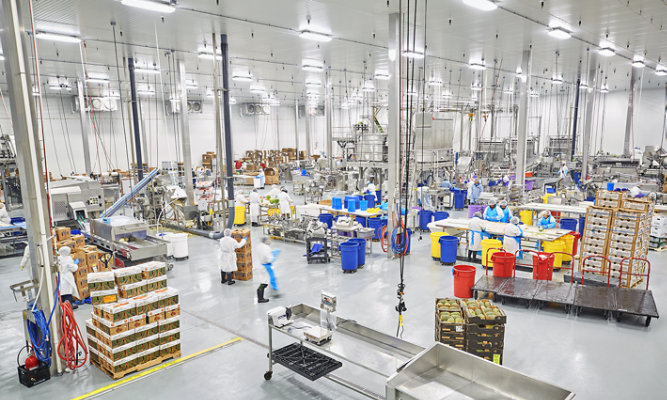
Figure 3. In a food processing facility, a consistent, bright finish across coated IMP walls and resinous floors supports washdown efficiency and simplifies inspection.
The topcoat is Sher-Loxane® 800, a polysiloxane finish. This is where the system separates itself from some competing alternatives. The polysiloxane is hydrophobic: water beads on the surface rather than sitting on it, which makes cleaning faster and more thorough. It resists the sanitizers most commonly used in food and beverage facilities and has been tested for compatibility with a range of industry-leading cleaning chemicals. The finish maintains a bright white appearance without the yellowing that epoxy topcoats develop over time, and it holds up under UV exposure for long-term color stability. The result is a smooth, seamless surface that’s easier to inspect, faster to wash down and less prone to the degradation cycle that drove the work in the first place (Figure 3).
The polyurea layer handles flexibility, seam bridging and waterproofing. The topcoat provides the finished surface that supports cleaning, inspection and impact resistance. That combination is what makes the system relevant for aging IMP walls in active plants. Where wall panel movement occurs by thermal shock, the washdown is aggressive and the auditor will have focused attention.
The system meets the U.S. Department of Agriculture (USDA) requirement for incidental food contact and supports compliance with USDA and U.S. Food and Drug Administration (FDA) hygiene requirements. Low-VOC and low-odor chemistry reduces impact on adjacent production areas during application. It can also be applied to ceilings, which is a useful option in facilities where overhead surfaces face similar washdown and moisture exposure.
For facilities where shutdown windows are more generous or thermal shock is less of a concern, other resinous wall systems – including ResuWall™ FX, ResuWall™ Aqua FR and ResuWall™ Aqua GR – offer alternative approaches with fiber reinforcement, mesh reinforcement or flexible epoxy membranes. Each has a purpose depending on the substrate, the exposure and the available downtime. But for IMP panels in active food and beverage production where speed, flex and washdown resistance are the constraints, the IMP Flex Wall Restoration System was built for that set of conditions.
Fitting the Shutdown Window
Most food and beverage plants cannot take a refrigerated room offline for several days to address wall deterioration. Maintenance work has to fit around production and sanitation schedules, often in a compressed window over a weekend or between runs. That reality is one reason this system makes more sense as a maintenance, repair and operations (MRO) solution than a traditional multi-coat wall system.
The system’s polyurea base coat is central to that advantage: because it is spray-applied and cures within seconds of hitting the wall, the applicator can build thickness quickly without waiting through extended cure windows between coats. The topcoat can then follow on a much faster timeline than would be typical with conventional multi-coat wall systems, which may require up to four separate applications stretched across multiple days. In a typical IMP wall restoration sequence, prep begins after the last shift on Friday, the coatings are applied on Saturday and the area is back in service by Sunday evening for Monday morning production.
One thing to plan around in freezer work: the polyurea base coat cures at very low temperatures, but the Sher-Loxane 800 topcoat requires a minimum of about 22°F and will cure more slowly in cold conditions. Therefore, freezer rooms typically need to be brought up to temperature before topcoating, which is pretty standard since the space has to be emptied and cleaned for the project anyway. A pre-job conference between the installer, the facility owner and a coatings representative from Sherwin-Williams is standard practice to align on shutdown timelines and cure schedules before any work starts.
The turnaround advantage is one reason facilities may choose restoration over replacement. Removing and replacing IMP panels is a larger, more disruptive process. Recoating an aging but still sound IMP wall can often be planned and executed more efficiently, while also eliminating the seam-related maintenance problem that drove the work in the first place.
Getting the Substrate Right
Like any coating system, the IMP Flex Wall Restoration System is only as good as what’s underneath it. Unsound coatings have to come off and the substrate needs a proper profile before anything can be applied.
For IMP panels, that means creating a 2- to 3-mil blast profile on the surface by performing a brush blast per SSPC SP-16 standards for nonferrous metals. Because the panel skin is thin, that work must be controlled carefully. Too aggressive a blast can warp the panel or blow through it. The goal is to create the anchor profile needed for coatings adhesion without distorting the panel itself. Any panels with significant corrosion or structural damage should be replaced before coating begins. This is a restoration system for sound substrates, not a way to coat over structural failure.
For concrete and CMUs, the standard is a concrete surface profile of CSP 2 to 3 per International Concrete Repair Institute (ICRI) guidelines. Block filler can smooth out voids on porous CMU surfaces before the system goes on, addressing the porosity that makes bare concrete so difficult to sanitize in a washdown environment.
The application requires plural-component spray equipment and a qualified contractor who can achieve the specified build and membrane continuity. This is not a brush-and-roller maintenance task for an in-house crew between shifts, and that is part of the point. The contractor requirement is less a complication than a quality-control measure. The work needs to be done correctly the first time if the plant expects it to stay off the maintenance list for more than a few months.
Transitions, Ongoing Upkeep and Where to Start
At wall-to-floor transitions, the treatment depends on the existing layout. In most cases, the wall system terminates at the integral cove, with sealant applied from the wall down to the cove. Where a larger curb is present – two feet or more – the system can extend over the curb and tie into the floor for a more continuous transition. The goal either way is to eliminate vulnerable interfaces that collect moisture and resist cleaning (Figure 4).
Once the wall is back in service, it still needs ordinary maintenance oversight. New penetrations for equipment, piping or signage should be sealed at the point of contact to keep moisture from working behind the membrane. If the finish shows wear, the topcoat can be abraded and recoated. Damage that extends into the polyurea layer would require specialty spray equipment and a qualified applicator; yet, that is uncommon in a system designed to absorb impact and stand up to aggressive washdowns. The difference is that these repairs are being made to a system that holds, rather than to another temporary patch on a failing surface.
For many plants, the correct initial step is not choosing a particular product or scheduling an applicator; it’s instead documenting the extent of the problem and then knowing the best means for repairs. Sherwin-Williams asset protection managers can work with facility owners to evaluate wall condition: peeling coatings, damaged panels, open joints, corrosion, worn sealant, impact damage from traffic and more. Each finding gets documented with a recommended course of action, including what surface preparation is needed, what system fits the exposure and how the work can be sequenced within the production schedule. From there, the team connects the facility with qualified installers, coordinates pre-job conferences and supports the project through completion.
That is how wall maintenance moves from reacting to findings one at a time to planning around risk, downtime and priority. For aging IMP walls, the value is a cleaner room and sealed seams, reduced moisture risk and a wall system that’s better matched to how the facility actually operates. There’s also a handy a documented record to show for it.
Figure 4. A food and beverage processing area showing a resinous floor system with a cove base transition to IMP walls. This type of interface would be assessed for cleaning access and moisture risk during a site evaluation.
ABOUT THE AUTHOR
Feraas Alameh is Market Segment Manager – Food & Beverage for Sherwin-Williams Protective & Marine. He has 15 years of experience in the coatings industry, leading various market segments with an emphasis on business and market strategy, particularly in consumer packaged goods and industrial coatings. He earned his bachelor’s degree from Cleveland State University and has completed continuing education programs at the Weatherhead School of Management of Case Western Reserve University and the Fisher College of Business at The Ohio State University. Contact: Falameh@sherwin.com
Quintin McKenna is Asset Protection Manager, Manufacturing & Processing, for Sherwin-Williams Protective & Marine. He has nearly 19 years of experience with Sherwin-Williams, including roles in protective and marine sales and business development. In his current role, he works with facility owners and operators to assess asset condition and develop coating recommendations for manufacturing and processing environments. McKenna is a certified NACE coating inspector and holds HACCP and AMPP Basic Coatings Inspector credentials. He earned his bachelor’s degree from Eastern Illinois University. Contact: Quintin.R.Mckenna@sherwin.com
Discover More
Industry Expertise and Innovation
See how we help customers find customized solutions for their project and application challenges.

Industry Solutions
Explore technology and innovation to protect your most valuable assets.
LEARN MOREProduct Lookup
Find out more about our innovative coatings for a variety of industries.
FIND A PRODUCT